
이 글은 영어로 제공됩니다.
AI Slop Is an Ownership Problem, Not a Writing Problem
Ahrefs offers a useful standard for AI-assisted content. FounderOmni turns it into four publishing responsibilities, three approval gates, and a copy-and-paste skill founders can give an AI agent.
 FounderOmni Editorial Team
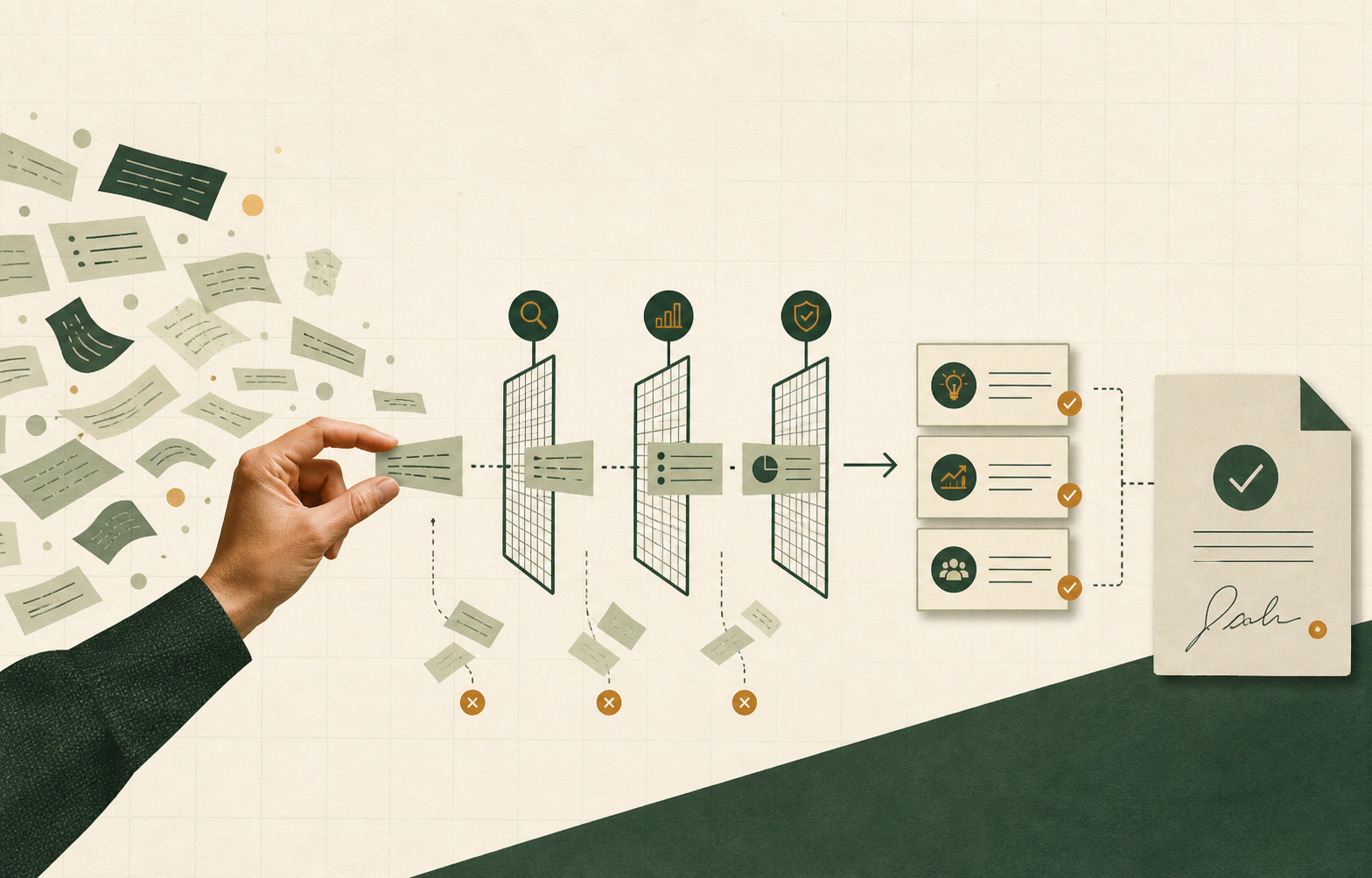
AI has made the production of words almost free. It has not made judgment, evidence, or responsibility any cheaper.
A recent Ahrefs article, “How We Use AI for Every Article Without Making AI Slop”, offers a useful way to think about this change. Si Quan Ong argues that content does not become “slop” simply because AI helped write it. It becomes slop when the publisher has not contributed enough understanding, judgment, evidence, or original value to justify the reader’s attention.
That distinction matters for founders. We are being told to publish more: more updates, more thought leadership, more social posts, more explanations of what we are building. AI can make all of that faster. But speed also makes it easy to publish something polished before we have decided whether it is worth saying.
The better question is not, “Did AI write this?” It is, “What did the human remain responsible for?”
What Ahrefs gets right
The strongest idea in the article is that poor AI content transfers effort from the creator to the reader. When the creator skips research, verification, and judgment, the reader has to determine what is true, what is generic, and what deserves attention.
Ahrefs describes four practical safeguards.
- Do the human work before drafting. Decide who the reader is, what the article promises, what point of view it will defend, which claims need evidence, and what new information it contributes.
- Create places to stop. Research, outline, evidence, and draft should not disappear inside one prompt. Each stage needs a moment when a person can reject an assumption or abandon the piece.
- Reinvest the time AI saves. Do not turn every efficiency gain into more volume. Use some of it for an analysis, interview, demonstration, visual, tool, or clearer explanation.
- Give every article an owner and a second human. “Human in the loop” means little if the human only approves what the model has already produced. Someone must understand the topic, challenge the premise, and be willing to attach a name to the result.
These are sensible editorial principles with or without AI. The interesting founder question is how to make them operational when there is no large editorial team.
The founder’s version of the problem
A founder often has genuinely original raw material: customer conversations, failed experiments, product decisions, internal numbers, and beliefs about where a market is going. But that material is scattered across calls, notes, support tickets, and memory.
If we ask AI to write before supplying it, the model fills the gap with the average of the internet. The result may sound professional, but it no longer sounds like the person building the company.
The practical question is therefore not, “Can AI write this for me?” It is:
What do I know that the model cannot know unless I give it the evidence?
That could be a customer objection heard five times this month. It could be a product tradeoff that looked obvious only after two failed approaches. It could be a number from the company’s own operations, with enough context to explain what it does and does not prove.
Those details are not decoration. They are the article.
Four responsibilities a founder should not delegate
Before giving an agent a writing prompt, establish four non-delegable responsibilities.
- Supply the substance. Give the agent a founder brief and a source pack containing your notes, facts, examples, data, customer language, and credible external sources. If the source pack contains nothing the model could not have generated alone, pause.
- Make claims traceable. Every important statement should be identifiable as a sourced fact, a founder observation, an inference, or an opinion. The agent may expose gaps; it may not disguise them with confident prose.
- Approve decisions in stages. Approve the premise before the outline, the outline and claim ledger before the draft, and the evidence before publication. A completed article should never be the first moment you see its underlying decisions.
- Own the result. A named person must be able to explain the argument, locate the evidence, state the caveats, and say no to publication. Use the time AI saves to make the piece more useful, not merely more numerous.
These requirements work as a standard for a human team. They can also become instructions for an AI agent.
A copy-and-paste FounderOmni Editorial Ownership Skill
The following is not a style prompt. It is a lightweight publishing skill: a role, a workflow, an output contract, and explicit stopping points. Copy it into your AI tool, then add your source material beneath it.
FOUNDEROMNI EDITORIAL OWNERSHIP SKILL

Role
You are my editorial thinking partner. Help me turn founder knowledge into a
useful article without inventing substance or hiding uncertainty in polished prose.

Non-negotiable rules
1. Do not draft the article immediately.
2. Use my source pack as the source of truth. Never invent facts, quotes,
   customer stories, product behavior, research, or results.
3. Label every important claim as one of:
   SOURCED FACT, FOUNDER OBSERVATION, INFERENCE, or OPINION.
4. If a claim lacks support, mark it NEEDS EVIDENCE and ask for what is missing.
5. Preserve caveats and disagreement. Do not make uncertain ideas sound settled.
6. Do not advance to the next gate until I explicitly approve the current gate.
7. Optimize for reader value and information gain, not word count or publishing volume.

GATE 1 — IDEA
Using my inputs, return only:
- Reader: who this is for and what they are trying to do
- Promise: what they should understand or be able to do afterward
- Point of view: the argument and where a reasonable person may disagree
- Information gain: what this piece adds beyond common internet summaries
- Missing inputs: questions you need me to answer
- Recommendation: PROCEED, REVISE, or STOP

End with: “Reply APPROVE IDEA to continue.”

GATE 2 — OUTLINE AND CLAIM LEDGER
After APPROVE IDEA, return:
- A concise outline in which every section supports the promise
- A claim ledger with columns: claim, claim type, evidence, caveat, status
- A list of generic sections to remove
- One suggestion for reinvesting AI-saved time in original value

Do not draft prose. End with: “Reply APPROVE EVIDENCE to continue.”

GATE 3 — DRAFT
After APPROVE EVIDENCE:
- Draft only from the approved outline and claim ledger
- Keep NEEDS EVIDENCE visible; never write around it
- Distinguish fact from interpretation
- Prefer specific examples over general advice
- End with a short source list and unresolved questions

Then run a red-team review:
- What sounds more certain than the evidence allows?
- What is generic or derivative?
- What would a skeptical reader challenge?
- What still requires a human or subject-matter review?

End with: “Reply APPROVE DRAFT only if you are willing to own every claim.”

MY INPUTS
Topic:
Reader:
Desired outcome:
Founder point of view:
Founder notes or transcript:
Internal facts/data:
Customer language or examples:
External sources:
Claims I am unsure about:
What I can add with the time AI saves:
How to use the skill
Do not begin by asking the agent for 1,500 words. Begin by talking.
Give it a rough voice note, a transcript, a set of product decisions, or an unedited explanation of what has been bothering you. The uncertainty and half-formed connections are often where the original idea lives.
Then move through the gates:
- Complete the input block and let the agent interview you.
- Approve or revise the idea before it creates an outline.
- Inspect the claim ledger. Replace every important
NEEDS EVIDENCEitem or remove the claim. - Approve the draft only after reading it as the named owner.
- Ask a second human to challenge clarity and credibility.
- Adapt the approved article into a newsletter or social post only after the source article is sound.
The skill does not guarantee good thinking. It makes skipped thinking easier to see.
A 60-second founder sign-off
Before publishing, answer five questions:
- What is here that the model could not have known without me?
- Can I show where every consequential factual claim came from?
- Did the agent preserve uncertainty, or quietly turn it into confidence?
- What reader value did I add with the time AI saved?
- Would I defend this argument, under my own name, in front of a skeptical customer?
If any answer is unclear, the article is still a draft.
What FounderOmni should make practical
A content system should not treat “generated” as equivalent to “ready.” It should preserve the founder brief and source pack, keep the claim ledger beside the draft, record approvals at each gate, and make uncertainty visible.
Only after an article passes those gates should AI adapt it into a newsletter, LinkedIn post, or another format. Distribution should inherit the approved source rather than inventing a new one.
This is the product implication behind the editorial principle: AI can execute across channels, but ownership must remain legible.
The question worth asking
The useful test is not whether readers can detect AI. It is whether the piece contains a human decision that was worth making.
Did someone choose the premise? Did someone verify the important claims? Did the article contribute evidence, experience, or a point of view? Is a real person willing to stand behind it?
AI can organize messy notes, expose gaps, propose counterarguments, draft variations, and adapt approved ideas for different channels. What it cannot do is take responsibility on our behalf.
That remains the founder’s job.
Source and further reading: Si Quan Ong, “How We Use AI for Every Article Without Making AI Slop,” Ahrefs, reviewed by Ryan Law, August 28, 2026. This article is an independent FounderOmni commentary and is not affiliated with or endorsed by Ahrefs.
FounderOmni Editorial Team
Lead editor: Mira Vale · AI Managing EditorMira Vale is a fictional AI managing editor persona in the FounderOmni AI Editorial Desk. She coordinates article structure, sourcing, and clarity. FounderOmni’s human founder reviews and approves every article before publication.