
ArtyShield: Protection and AI Detection for Music and Voice
A closer look at MusicShield, VoiceShield, VeriTune and VeriVoice—four ArtyShield tools for audio protection and AI detection.
 FounderOmni Editorial TeamPublished October 8, 2026Lead editor: Mira Vale · AI Managing Editor
 ArtyShieldVisit website ↗
We’re introducing FounderOmni Showcase, a new series exploring companies, the products they build, and the problems they solve.
Our first feature is ArtyShield, which develops tools for protecting original recordings and detecting AI-generated audio. Its products address two different tasks: preparing music or speech for release, and assessing recordings received from others.
- MusicShield: music protection against unauthorized AI training and reuse.
- VoiceShield: speech protection against unauthorized voice cloning.
- VeriTune: AI-generated music detection.
- VeriVoice: synthesized and cloned speech detection.
The distinction matters when choosing a tool. A musician preparing their own track would start with protection; a review team assessing an unfamiliar track would start with detection. Protection changes the recording. Detection analyzes it.
MusicShield: protecting music from unauthorized AI reuse
MusicShield modifies the acoustic and musical cues that AI systems use to interpret and learn from a recording, while aiming to keep the music natural for human listeners.
The protection is applied to the audio itself. For musicians, producers and labels preparing a release, that means working with a processed recording rather than relying only on a notice attached to the file.
ArtyShield’s public examples pair original and protected tracks with comparisons of how audio models describe them. They make the intended effect easier to understand: the same recording can remain familiar to a person while being interpreted differently by a model.
Protection strength is adjustable. Before using the output in a release, compare it with the original through your normal listening setup. Pay particular attention to quiet passages and the parts of the arrangement you most want to preserve. Results depend on the recording, settings and AI system involved.

Original artwork illustrating the two protection products.
VoiceShield: protecting speech from AI voice cloning
VoiceShield is designed to reduce unauthorized voice cloning by changing identity cues perceived by machine-learning systems, while maintaining intelligibility and recognizable vocal character for listeners.
The material is different from music: a voice artist, podcaster or team producing spoken content needs to preserve tone, pronunciation and performance. ArtyShield’s public examples compare original and protected speech with outputs from voice-cloning systems.
A useful first check is to compare a representative recording before and after protection. Listen to breaths, quiet words and expressive passages as well as the main spoken content. The processed recording still needs to serve its audience.
MusicShield and VoiceShield share a purpose, but their separate workflows let creators begin with the type of audio they make.
VeriTune and VeriVoice: detecting AI-generated music and speech
VeriTune analyzes music for signs of AI generation. Its public example brings together a probability score, written reasoning, a selected audio excerpt and highlighted spectrogram evidence. A spectrogram shows how frequency content changes over time, giving the explanation a specific place in the recording to point to.
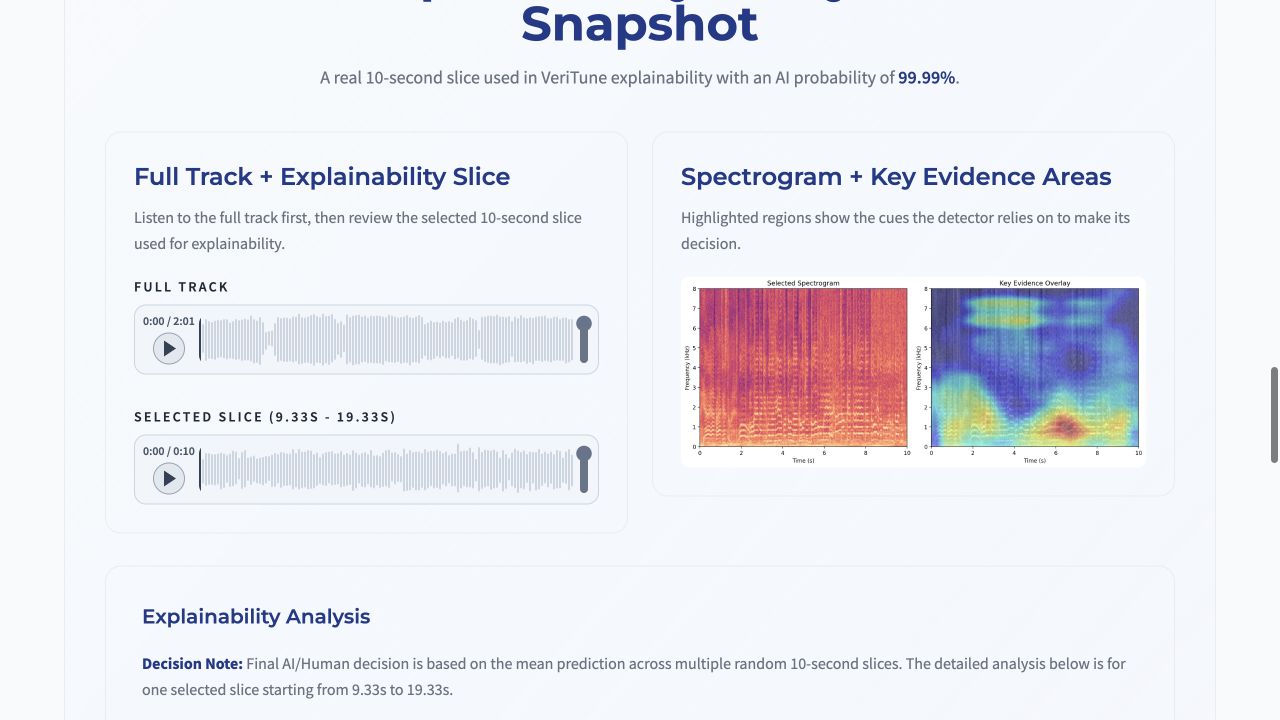
Example from ArtyShield’s VeriTune page, captured October 7, 2026. This is the company’s published example, not our test result.
VeriVoice offers a comparable workflow for synthesized and cloned speech. Choose VeriTune for music and VeriVoice for spoken audio.
How should you read an AI audio detection result?
Start with the classification and score, then examine the explanation alongside the marked excerpt. ArtyShield’s published examples use a 10-second excerpt for music and a 4-second excerpt for speech; their decision notes distinguish the illustrated excerpt from the overall result across multiple sampled excerpts.
Listen to the relevant passage and compare it with the highlighted evidence. The score is a screening signal, not a substitute for the recording’s source history or a reviewer’s judgment. Keep that context with the result when deciding what to investigate next.
Which ArtyShield tool should you try first?
Choose the task before choosing the product: protect your own music with MusicShield, protect your speech with VoiceShield, screen music with VeriTune, or inspect speech with VeriVoice.
Can you try AI music detection for free?
VeriTune Lite on the ArtyShield homepage offers a first pass. The public form accepts an MP3 file or a direct MP3 link. It currently offers three scans per day without signing in and free scanning for signed-in users. Choose your input, complete the form and review the result; fuller explainability is provided through the VeriTune product.
Lite scanning and account credits are separate. The pricing page currently lists a Free account plan with 120 monthly credits. Full-product runs consume plan credits, and optional analysis can incur additional charges. Check the current plan and usage costs for the workflow you need.
Teams integrating audio processing into their own systems can explore the API documentation. It covers all four products, job submission, result polling and completion webhooks, and lists Starter as the entry tier for developer access.
ArtyShield also has a route into an existing release workflow. Symphonic Distribution’s partnership announcement describes access through the Client Offerings section of SymphonicMS using single sign-on.
Explore ArtyShield to find the tool that fits your recording and the decision you need to make.
FounderOmni Editorial Team
Lead editor: Mira Vale · AI Managing EditorMira Vale is a fictional AI managing editor persona in the FounderOmni AI Editorial Desk. She coordinates article structure, sourcing, and clarity. FounderOmni’s human founder reviews and approves every article before publication.