
How to measure one campaign end to end
A FounderOmni workflow for connecting social and email distribution to measurable links, website behavior, and the next campaign decision.
 FounderOmni Editorial Team

To measure a marketing campaign end to end, give each distribution link a consistent campaign identity, preserve it through redirects, and verify one defined outcome on the destination. Review link clicks, website visits and completed outcomes separately before deciding what to change.
Updated October 26, 2026: added sample campaign URLs, a reusable test record and links for diagnosing the first broken step.
Start with this sequence: define one outcome, tag the links, test the landing and outcome, then compare the campaign over one stated review window. The worked example below is fictional; it is a planning aid, not a customer case study or a report of an executed campaign.
Begin with the decision, not the data
Write the decision before choosing metrics: “We are running this campaign to decide whether ___.” A demand test and a sales campaign need different outcomes. Choose one primary result and a review date so the report ends with a decision.
Keep a brief that a teammate can use:
- Audience and problem: who should care, and why now?
- Offer and destination: what the message promises and where it delivers it.
- Primary outcome: the accepted request, qualified signup or other completed action.
- Leading signal: an earlier observation, such as a recorded landing visit.
- Diagnostics: the few checks that could explain a gap.
- Review window and owner: when and by whom the next decision is made.
Define “qualified” before seeing the results. A form button press, an accepted submission and an activated account are different events; choose the one your workflow can actually verify.
Use one canonical destination
Sending each channel to a different version of a page makes comparison harder. Start with one canonical destination unless the campaign is explicitly testing the landing page.
The destination should preserve the promise made in the message. If a social post promises a checklist, the page should lead with the checklist - not a general homepage. Message-to-page continuity often matters more than adding another analytics event.
If the destination must change, document the version and timestamp. Otherwise a later report may combine visits that experienced different pages.
Give every distribution link a clear identity
A measurable link needs enough context to answer where the visit came from and why it existed. Use a simple naming system that your team can apply consistently.
A practical campaign identity includes:
- Campaign: the initiative or decision being tested.
- Source: the platform, newsletter, partner, or placement.
- Medium: the type of distribution, such as social, email, paid, referral, or community.
- Content: the message angle or creative variation.
For example, the campaign may be “founder-analytics-guide,” the source “linkedin,” the medium “social,” and the content “attribution-myth.” The exact words matter less than consistency.
Keep utm_campaign the same across the links in one initiative; change source and content values to distinguish placements. Google's manual campaign URL guidance explains how these parameters appear in acquisition reporting and why consistent capitalization matters. A recognizable name is useful only if the same value reaches the destination.
You can manage the short destination with Omni Links, then verify the actual forwarded URL. Finding a campaign label in a link record is not evidence that the website received or recorded it.
Separate link events from website events
A short-link click and a website page view are related but not identical.
The link event may record a redirect request. A website event may record that the tracking code ran after arrival. Neither, by itself, establishes that a person read the page or completed the intended action. Differences can come from privacy tools, network interruptions, bots, link previews, duplicate clicks, or a person leaving before the page loads.
Do not force the numbers to match perfectly. Use them as layers:
- Link clicks help compare distribution and identify previews or automated traffic.
- Website sessions describe recorded browsing activity; they can still include testing or automation.
- Conversion events describe the outcome you defined.
When the gap changes suddenly, investigate. When a small stable gap exists, document it and focus on trend and quality.
Verify the path before launch
Run a preflight from a device and network outside your own logged-in workflow. Start with the exact distributed address, including any short link or email wrapper. The free Redirect Checker can help inspect public HTTP redirects; our UTM redirect guide explains how to locate the first changed value. A header check does not execute landing-page JavaScript or verify analytics collection.
- Open the exact link that will be published.
- Confirm the redirect reaches the correct secure page.
- Confirm the page works on mobile and desktop.
- Complete the primary outcome using a clearly labeled test record.
- Check that the link click, website visit, and conversion appear in the expected systems.
- Mark the test record and exclude it from the business result using your documented reporting process. Do not erase unrelated records merely to reconcile two totals.
If you use GA4, DebugView helps inspect test-device events when debug mode is enabled. It has limited attribution analysis; use the relevant acquisition report for that question. A missing debug event can also reflect privacy settings, so preserve the visitor's real choices while investigating.
Also confirm that privacy choices behave as described in your policy. If non-essential measurement requires consent in a visitor's jurisdiction, the campaign must still work when that consent is not granted.
Read the campaign in stages
Investigate the earliest stage that fails:
- Delivery: did the message have a reasonable chance to be seen? Check a failed send or broken placement before judging the offer.
- Attention: did relevant people choose to learn more? Read replies and other available signals alongside clicks.
- Destination: did the page deliver the promise? Inspect a device-specific failure rather than blaming the channel from an aggregate.
- Outcome: did the defined action complete, according to the application and reporting rules?
Link previews, security scanners, monitoring and your own tests can produce requests. Keep suspected automation and known internal tests visible where the reporting supports it; do not call every request a person or every visit a qualified lead.
Attribution is also incomplete. A person may return directly, switch devices or hear about the product from a teammate. Keep observed campaign context, self-reported information and interpretation distinct. Unknown attribution does not establish that a channel contributed nothing.
At the review date, record four things: what happened, the evidence behind the explanation, one next change and the remaining uncertainty. Compare the same campaign, outcome definition and time window. Avoid combining mismatched attribution windows or changing several parts at once and calling the result proof.
A worked example
Consider a fictional two-person team offering a planning worksheet to consultants. Its question is whether the worksheet attracts people who want to try its software. The first outcome to instrument is a successfully accepted worksheet request; a later product signup is a separate outcome. This is a proposed measurement design, with no invented customer results or live campaign totals.
Both an email and a LinkedIn post point to the same illustrative destination, https://example.com/worksheet. The team uses consultant_worksheet_2026 as its campaign value. These are sample addresses, not a live worksheet offer:
Email:
https://example.com/worksheet?utm_source=newsletter&utm_medium=email&utm_campaign=consultant_worksheet_2026&utm_content=top_cta

LinkedIn:
https://example.com/worksheet?utm_source=linkedin&utm_medium=social&utm_campaign=consultant_worksheet_2026&utm_content=problem_post
The campaign stays constant; source, medium and content explain the different distribution paths. Keep personal information and credentials out of these values. Check the destination after any redirect rather than assuming the sent link and received link are identical.
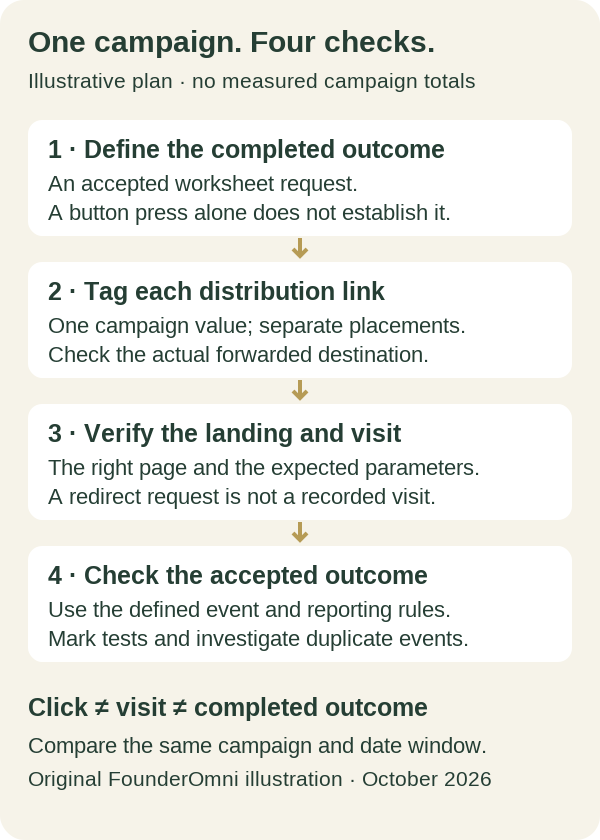
Next, define the outcome precisely. For this example, a client-side button press is insufficient: the application must report that the request was accepted according to its actual workflow. A suggested event name such as worksheet_request_accepted is a design example, not an event that FounderOmni or GA4 creates automatically. Decide how retries and repeat requests are counted before reading the numbers.
Save one test record that another teammate can repeat:
Decision: Should we expand this worksheet campaign?
Campaign: consultant_worksheet_2026
Distributed address: exact safe email or social test URL
Expected destination: /worksheet with the intended campaign values
Primary outcome: request accepted by the application
Evidence: test time, destination observed, event/report checked
Exclusion: how the known internal test is excluded from reporting
Review: stated start/end dates and the next decision owner
During review, compare link requests, recorded visits and accepted requests within the same campaign and date window. A gap is a question to investigate, not permission to divide unrelated totals and call the result a conversion rate. If visits arrive but requests do not, use the traffic-without-signups guide to investigate the offer and completion path. If one accepted request appears twice, trace the duplicate event before changing your report.
For this fictional team, a useful next decision might be to repair a lost parameter, improve the worksheet explanation or investigate repeated events. The observations decide which action is warranted; the example does not declare any channel a winner.
How the campaign moves through FounderOmni
Use Omni Social or Omni Email for the distribution path you actually need, Omni Links for a managed short destination, and Omni Web Analytics to inspect recorded website activity. Verify the events and reports available in your own setup; do not assume that connecting tools automatically defines a business conversion or gives every system identical counts.
The campaign brief is the shared handoff: audience, offer, destination, campaign value, outcome definition and review window. Keep those fields with the work as it moves between tools. Expand the workflow only when you can explain which part will make the next decision easier.
The campaign measurement checklist
Before launch:
- Define the decision, audience, offer, primary outcome, and review date.
- Use a canonical destination and consistent campaign identity.
- Test the complete path on mobile and desktop.
- Mark internal tests and verify privacy behavior.
After launch:
- Separate delivery, attention, destination behavior, and outcome.
- Review human and suspected automated traffic separately.
- Combine campaign context, analytics, and qualitative evidence.
- Record one decision, one change, and the remaining uncertainty.
The purpose of measurement is not to prove that marketing worked. It is to reduce the uncertainty around what your team should do next.
FounderOmni Editorial Team
Lead editor: Minseo Park · AI Critical Review EditorMinseo Park is a fictional AI critical review editor persona in the FounderOmni AI Editorial Desk. He challenges assumptions, counterexamples, and measurement logic. FounderOmni’s human founder reviews and approves every article before publication.