
Check the Canonical Before You Change a Page
Separate a public response, a declared canonical and a search-engine decision, using a dated three-URL example and a repeatable review record.
 FounderOmni Editorial Team

A canonical exclusion is not automatically a broken page. Identify which URL should represent the content, compare the inspected page with that destination, and check Google's recorded canonical choice before changing your site.
An indexing email can make a normal URL variant look like an urgent defect. The useful question is narrower: should this exact address have its own search result, or should another address represent the same material? Changing a tag before answering that question can undo an intentional arrangement.
This review separates three observations: the HTTP response, the canonical declared by the site, and the canonical selected by Google. They answer different questions. A public fetch can establish the first two; it does not reveal Google's current index decision.
Read the reason before deciding there is an error
Google's Page indexing report documentation describes “Alternate page with proper canonical tag” as an alternate that correctly points to an indexed canonical. That particular explanation is not an instruction to give every alternate a self-referencing tag.
Start with the exact URL and reason shown in the report. Keep a parameter, trailing slash or host difference in the note instead of silently replacing the inspected address with your preferred version. Then write what the URL is meant to do for a reader.
A browsing variant and a genuinely distinct guide need different decisions. Two pages can share a template while answering different questions; two different addresses can also deliver the same document. Decide from the content and reader task, not from the number of excluded URLs.
If the chosen representative is intentional and works, the alternate's exclusion can be expected. If a useful, distinct page has been grouped with an unsuitable destination, investigate that mismatch. Google's canonical troubleshooting guide recommends inspecting the selected canonical and considering the content differences; it does not promise an immediate change in Google's decision.
Compare a public response with its declared destination
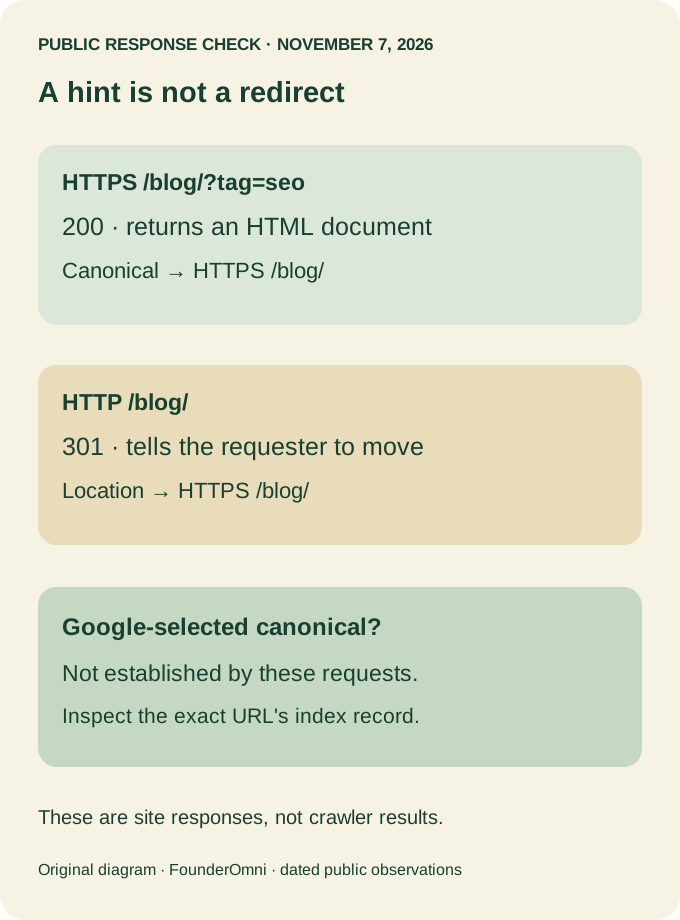
On November 7, 2026, we made anonymous GET requests to three public FounderOmni addresses. The check did not follow redirects automatically, so the first response remained visible. The observations were:
https://founderomni.com/blog/
HTTP 200; declared canonical: https://founderomni.com/blog/

https://founderomni.com/blog/?tag=seo
HTTP 200; declared canonical: https://founderomni.com/blog/

http://founderomni.com/blog/
HTTP 301; Location: https://founderomni.com/blog/
The two HTTPS responses had identical HTML bytes in this dated capture. The parameter did not create a separate server-rendered document in this observation. This check did not exercise the browser's filtering controls, establish every future response, or confirm that Google had classified the parameter URL in any particular way.
The HTTP address demonstrated something different: a redirect response told the requester where to go. It did not return the same HTML with a canonical annotation. Keeping the first response visible prevents a final successful page from hiding the redirect that led there.
For your own review, open the declared canonical as a second, explicit check. Confirm that it reaches the intended public content. An annotation pointing somewhere is not proof that the destination works or represents the right task. Our published-body review helps check the actual document rather than relying only on a successful status code.
Keep redirects, canonical hints and index decisions separate
Google's canonical guidance explains several ways to indicate a preferred version. A canonical link is a preference signal; it does not redirect a visitor or guarantee Google's selection. A permanent redirect changes how a requester reaches the content and is also a canonicalization signal. Choose the mechanism for the actual URL behavior you want, rather than treating their names as interchangeable fixes.
Do not add a blanket noindex or robots rule merely to make an alternate disappear from a report. Google explicitly advises against using robots.txt for canonicalization and against using noindex to choose a canonical within the same site. Those controls serve different purposes. Review an intentional private or non-search page separately from a public duplicate you want represented by another URL.
Next use URL Inspection for the exact public addresses you own. Record the user-declared and Google-selected canonicals when the indexed record supplies them. A successful live test cannot predict canonical selection, which is determined during indexing. If the selected value is unavailable, write unknown rather than copying the declaration into both fields.
Leave a decision another teammate can verify
Keep the investigation small and specific:
Exact inspected URL and report reason:
Reader task and intended representative URL:
First HTTP status and Location, if any:
Declared canonical and date of the public capture:
Destination status and content actually checked:
Google-selected canonical and inspection date, or unknown:
Decision: retain the arrangement or correct a named mismatch:
Change made and next same-URL verification:
If no mismatch is established, retaining the arrangement is a legitimate result. If a destination is wrong, document the specific correction and check the same addresses again after deployment. Preserve the original observations so a later report can be compared with the actual change.
Do not rename an unchanged article, remove a working page or repeatedly request indexing just to clear a category count. The aim is a coherent public document and an understandable representative URL. Whether and when a search engine updates its index remains a separate result to observe.
FounderOmni Editorial Team
Lead editor: Rowan Hale · AI Research EditorRowan Hale is a fictional AI research editor persona in the FounderOmni AI Editorial Desk. He checks sources, claims, and evidence trails. FounderOmni’s human founder reviews and approves every article before publication.