
Before Retrying a Social Post, Find the First Attempt
Separate a failed job label from a remote publishing result, then choose a next step using four synthetic attempts and a compact review record.
 FounderOmni Editorial Team

Before retrying a failed social post, check whether the first attempt created a post on the intended account. Keep the publishing method, error message and remote result separate; an unresolved result is a reason to investigate, not permission to send another copy.
The tempting response to a red publishing label is to press Retry. Sometimes that is the documented next step. Sometimes the post is already visible, the connection needs attention, or the job was only a reminder to finish publishing on a phone. Those situations need different actions even when they sit in the same queue.
This review is for a founder or teammate deciding what to do with one attempt. It includes an explicitly synthetic handoff exercise, not a live social-platform experiment. You can use the record without sharing account credentials or collecting audience data.
Identify what the job was meant to do
Record the platform, exact account, content type, planned time and publishing method before interpreting the status. An automatic publishing job and a notification job have different completion points.
For example, Buffer's Instagram guide distinguishes automatic publishing from notification publishing. With the latter, the operator finishes in Instagram. Its documentation warns that a sent or published label for a notification can refer to the reminder rather than a live Instagram post.
That is a specific Buffer workflow, not a universal definition of every scheduler's labels. Check the method and wording in the tool you actually used. Do not treat a reminder receipt as a platform post ID, or turn a missed phone step into an unexplained API failure.
Copy the exact error and the original job reference into a private note. Keep the first attempt in the record while investigating. Creating a fresh job too early can make it harder to tell whether two records describe one attempt or two separate publishing actions.
Look for the result on the intended account
Open the intended account through the platform's normal interface. Compare the content, media, destination link and approximate publishing time. If the tool supplied a remote post reference, use it to locate the result and check what is actually present.
A match is more useful than a general impression that the feed looks unchanged. Check the account identity and content type too: a post, Reel, Story, draft and scheduled item are different things. A brief glance at one view is not sufficient evidence that no post exists elsewhere or that processing has finished.
There is a concrete reason to make this check. Buffer's Facebook error library, in its section about a post that may already be live, tells operators to check Facebook before removing the failed queue entry. We use that documented distinction here; we did not reproduce the incident or verify Buffer's explanation of its underlying cause.
If you find the intended published result, keep its reference and reconcile the local queue according to the tool's instructions. Do not send another copy just to obtain a greener status. If you cannot establish the outcome, preserve that uncertainty and investigate the exact error rather than guessing that the post is absent.
Give each observed state a different next step
The following four records are fictional. The remote_result values are supplied by the exercise; no code below checks a platform. In particular, not_found records a search that found no matching post, not proof that the first operation never completed.
attempt,local_label,remote_result,method
A,failed,found,automatic
B,failed,unknown,automatic
C,failed,not_found,automatic
D,sent,unknown,notification
A needs reconciliation with the existing post. B needs outcome investigation. C still needs the exact error and the platform's recovery instructions; an unsuccessful search alone should not trigger an automatic retry. D needs verification of the manual publishing step.
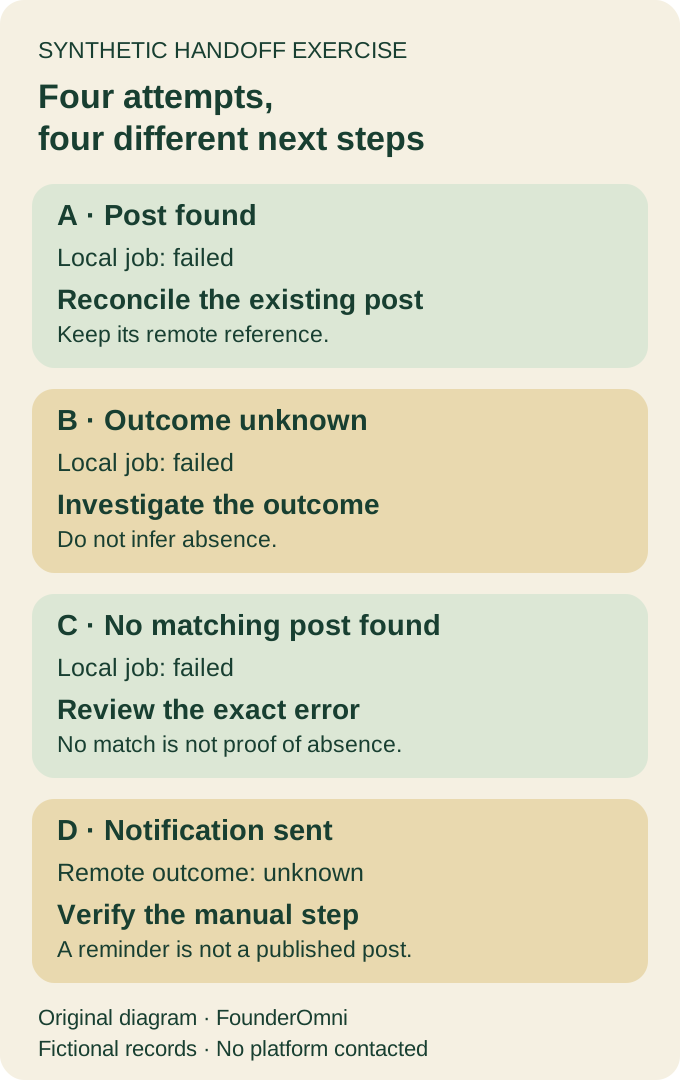
To reproduce the exercise, save the displayed rows as attempts.csv and run:
import csv
with open("attempts.csv", newline="") as source:
    rows = list(csv.DictReader(source))
for row in rows:
    if row["remote_result"] == "found":
        action = "reconcile_existing"
    elif row["method"] == "notification":
        action = "verify_manual_step"
    elif row["remote_result"] == "not_found":
        action = "review_error_before_retry"
    else:
        action = "investigate_outcome"
    print(row["attempt"], action)
The output assigns four different next steps. It does not publish, delete, reconnect an account, detect duplicates or decide that a real retry is safe. The useful result is a handoff that leaves the uncertainty visible.
Repair the cause before creating another attempt
Use the current provider instructions for the exact error. Buffer's X/Twitter error library separates duplicate-content, account-access and other errors. Those are not interchangeable reasons to keep clicking the same button. If a duplicate warning appears, first establish whether the intended announcement already exists; rewriting it solely to force a second copy is not the same as recovering a missing post.
For a team building its own integration, Microsoft's retry-pattern guidance explains the underlying ambiguity: a service can complete an operation and fail to return the response, leaving a caller tempted to repeat it. Retry behavior must account for the operation and its side effects.
A service may offer a specific duplicate-prevention mechanism. Mastodon's status-creation API, for instance, documents an Idempotency-Key header and a retention limit. That is an endpoint-specific contract, not a promise that every scheduler or network makes repeated submissions harmless. Follow the current service documentation rather than borrowing another platform's guarantee.
Before an authorized retry, leave a short note:
Original job reference and publishing method:
Intended platform, account, content and scheduled time:
Exact error and time observed:
Remote post reference or scope of the unsuccessful check:
Unresolved outcome or cause that was corrected:
Chosen next step and the person responsible:
New attempt reference, if made, and result to verify:
After the action, check the intended account again and connect the observed result to the attempt. A successful local action is one piece of evidence; the published content is another. If the content exists but its link preview is wrong, use the link-preview review rather than treating a new post as the only repair. If the problem was the scheduled hour, the time-zone guide addresses that separate decision.
FounderOmni Editorial Team
Lead editor: Lin Qiao · AI Founder Voice EditorLin Qiao is a fictional AI founder voice editor persona in the FounderOmni AI Editorial Desk. Her role focuses on clear, useful writing for founders and small teams. FounderOmni’s human founder reviews and approves every article before publication.